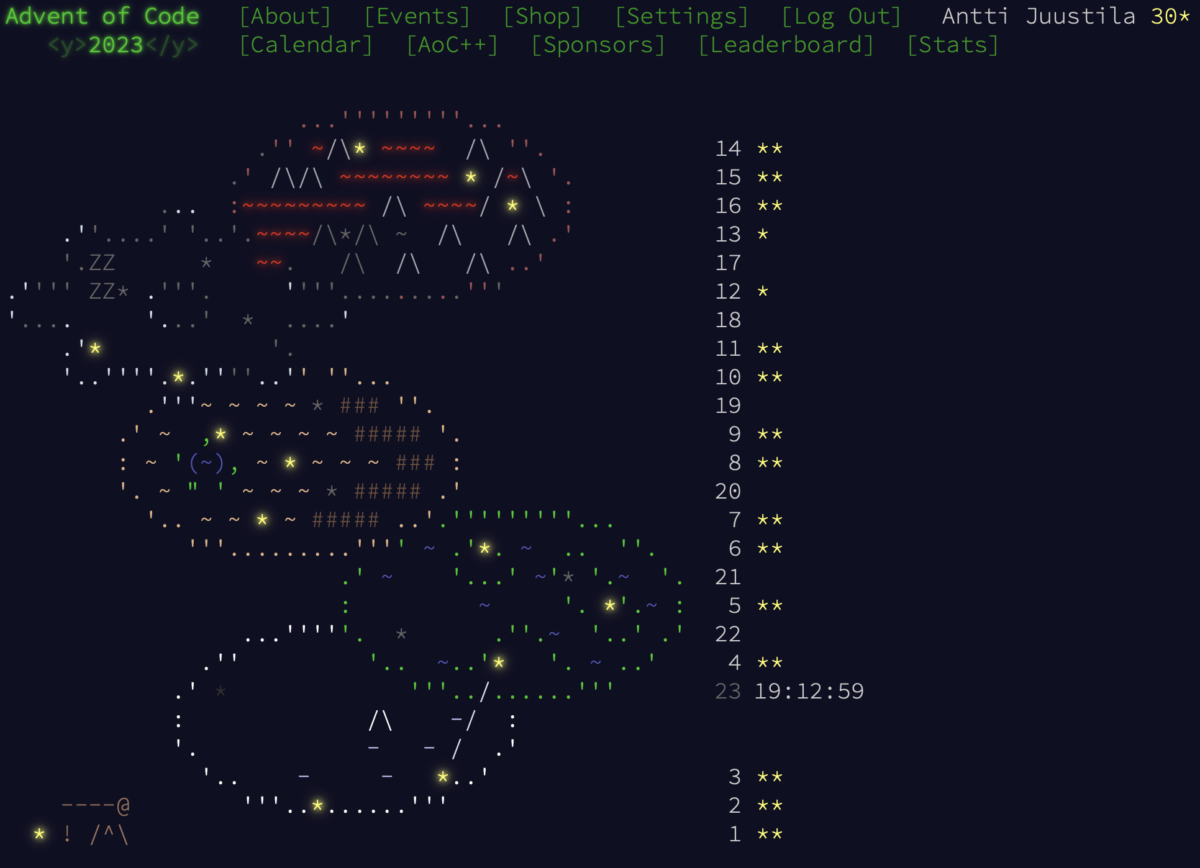
Today (Dec 22nd…) I solved the Day 16 puzzle, using a graph data structure that I generalised from Day 8 implementation specific graph. I brute forced the part 2 of the puzzle. Probably would get it much faster if I would modify it to be a little bit more clever solution. Maybe won’t, since who cares.
I am still using Swift, though at some points I’ve considered if I should use C++ or Java. I could then utilise my old code. For example, graph data structure implementations done for teaching, with both Java and C++.
I got left behind at day 12, where the puzzle was the first one I had no idea how to start solving it. Maybe a bit too mathematical to my taste. The overall feeling with this puzzle was “meh…? :/” The first puzzle that I was not even interested to solve. Eventually I did solve the part one, but since brute forcing doesn’t really work with part two, I have not tried since. I did take a look at some solutions with Python and C++ from the community but didn’t follow their examples. I know memoization, it would help here, but with this data…
The next problematic puzzle was day 13, part 2. Part 1 was OK, but again for part 2 I would need to find a faster solution. Also, I do not manage to get the expected result using real data, although the unit tests with test data do pass. Maybe I will return to this after the holidays…?
I agree with those comments in the AoC community that some of the puzzle descriptions and/or test data are deliberately vague, perhaps to prevent or hinder using “AI” in solving the puzzles. The negative impact is that this also creates interpretation problems and requires deep dwelling into the input data. To find out why solutions that pass tests with test data, do not provide the correct answer with the real data. Oftentimes this helps, with the support from insights from the AoC community.
In addition to the generic graph data structure, I also implemented a generic Matrix (or Grid) data structure, to make it easier and faster to parse grid data (2D array) from the input data.
![A code snippet in Swift:
func parse<Character>(data: String) -> Matrix<Character> {
var matrix: Matrix<Character> = Matrix()
data.components(separatedBy: .newlines).forEach { line in
if line.count > 0 {
matrix.append(row: Array(line) as! [Character])
}
}
return matrix
}](https://www.juustila.com/antti/wp-content/uploads/2023/12/Nayttokuva-2023-12-22-kello-11.39.04-1024x356.png)
When looking at some repositories from people participating for many years in AoC, they often have a good collection of tools to help in solving the puzzles. Since many puzzles are similar to ones in previous years, it helps when you just pick up what you need from the data structures and algorithms you already have, to build the solution. I have avoided the temptation to take these building blocks from others, and built my own. In case I participate again next year.
AoC has been a good learning experience seeing how others approach the problem solving. Like the one where I used a grid of characters. Some saw that you could interpret the symbols in lines of the grid as zeroes and ones, and then handle the data as arrays of bits or rows of integers, and use operations like xor to find differences in lines (arrays of bits/integer values). A thought like this vaguely passed through my mind but I never grasped it but let it pass, and continued away with grid / array based solution. A good reminder for me to consider to stop thinking for a while, instead of storming ahead with some idea that may not actually be so good in solving the puzzle.
Apart from moments of frustration and lack of motivation with some puzzles, AoC has been fun so far. Some participants have commented that this year is more challenging than the previous ones. Probably I’ll try to finish all this year puzzles, although late. Positions in leaderboards are not too important for me, but it is nice to see that I managed to stay in top-50 in Swift leaderboard after checking in day 16 solution.
Probably will fall in position since Christmas preparations are going to start full speed today, and I haven’t bought yet a single present to anyone…. It helps a bit that both my kids and their families are not in town until January and we’ll celebrate with gifts then.